Agentic AI — What's Behind the Hype?
If you follow technology news, you have almost certainly encountered the term “agentic AI” in the past year. It has become one of the most talked-about concepts in the AI industry — and like most trending terms, it is surrounded by a mix of genuine innovation, overhyped marketing, and real confusion.
This article cuts through the noise. We will explain what agentic AI actually is, how it differs from the AI tools most businesses already use, where it delivers real value today, and what its practical limitations are.
What Is Agentic AI?
Traditional AI tools are reactive. You give them an input, they produce an output. You ask ChatGPT a question, it answers. You feed data into a classification model, it returns a label. The human is always in the loop, directing each step.
Agentic AI is fundamentally different. An AI agent is a system that can:
- Receive a goal (not just a single instruction)
- Break that goal into subtasks autonomously
- Execute those subtasks using available tools and data sources
- Evaluate its own progress and adjust its approach
- Handle unexpected situations without human intervention at every step
Think of the difference this way: traditional AI is like a skilled employee who does exactly what you ask. An agentic AI system is like a competent manager who takes a high-level objective and figures out how to accomplish it — deciding what needs to be done, in what order, using which resources.
A concrete example
Traditional AI approach to expense reporting:
- Human uploads receipt photo
- AI extracts text from the image (OCR)
- Human reviews the extracted data
- Human enters data into the accounting system
- Human categorizes the expense
- Human submits for approval
Agentic AI approach:
- Human forwards a receipt email to the system
- Agent identifies it as an expense receipt
- Agent extracts all relevant data (amount, vendor, date, category)
- Agent cross-references the vendor against approved supplier lists
- Agent categorizes the expense based on company policies
- Agent enters the data into the accounting system
- Agent flags any policy violations for human review
- Agent submits for approval if everything checks out
- Agent follows up if approval is delayed
The human went from performing six manual steps to forwarding a single email. The agent handled the rest autonomously, escalating to a human only when necessary.
The Technical Architecture Behind AI Agents
Understanding the basic architecture helps demystify what agents actually do:
The reasoning loop
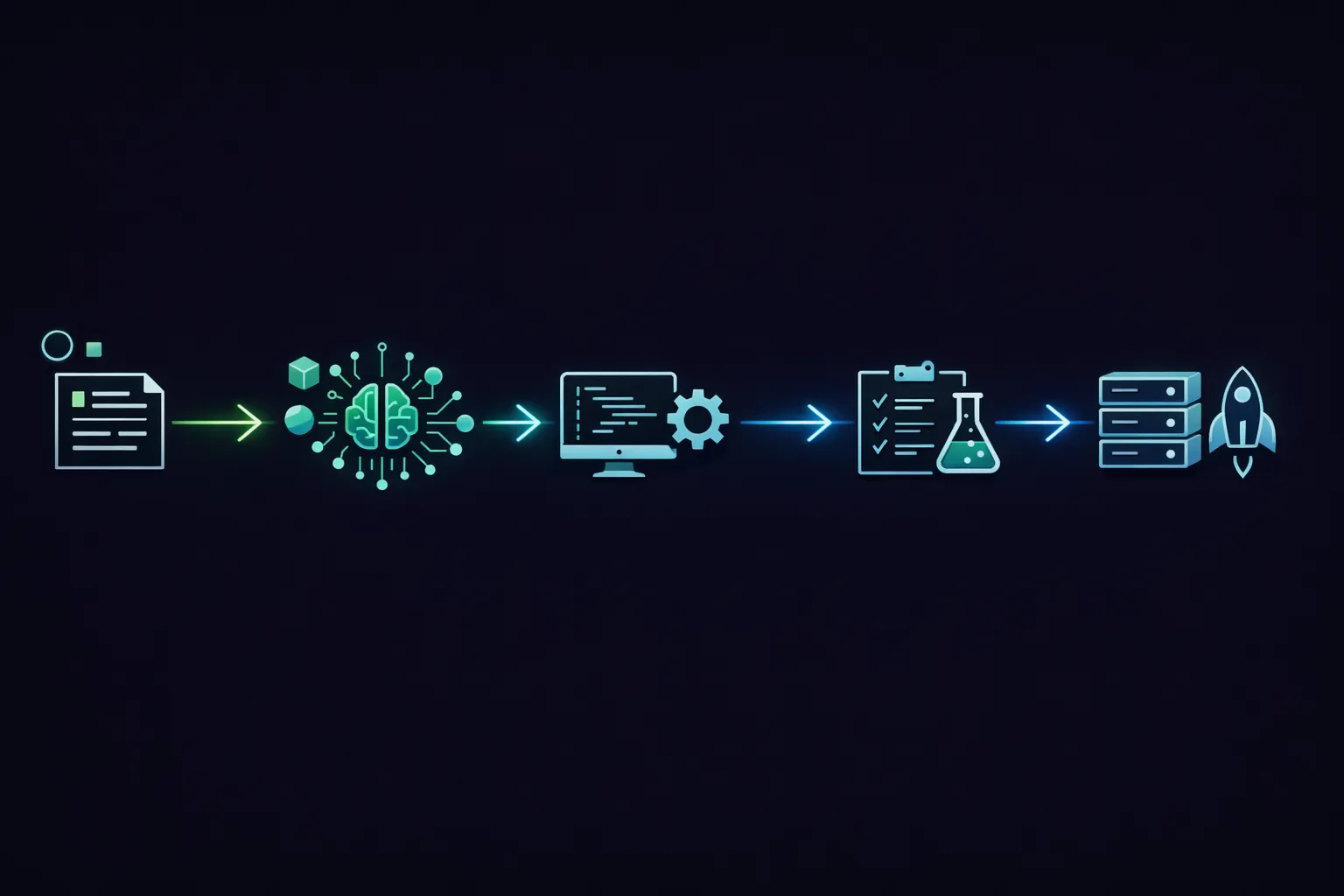
At the core of every AI agent is a reasoning loop — often called a ReAct (Reasoning + Acting) loop:
- Observe — The agent examines the current state: What information do I have? What has been done? What still needs doing?
- Think — The agent reasons about the next step: What action should I take? What tool should I use? What could go wrong?
- Act — The agent executes an action: calling an API, querying a database, generating content, sending a message.
- Evaluate — The agent assesses the result: Did the action succeed? Am I closer to the goal? Do I need to change my approach?
This loop repeats until the goal is achieved, the agent determines it cannot proceed, or it reaches a predefined limit.
Tool use
What makes agents powerful is their ability to use tools. A modern AI agent might have access to:
- APIs — CRM systems, accounting software, email, calendar, project management tools
- Databases — Query and update business databases
- Web search — Find current information from the internet
- Code execution — Write and run code to process data or perform calculations
- File systems — Read, create, and modify documents
- Communication channels — Send emails, Slack messages, or notifications
The agent decides which tools to use based on the task at hand. This is a crucial distinction from traditional automation (like RPA), where every step must be explicitly programmed.
Memory and context
Advanced agents maintain memory across interactions:
- Short-term memory — The context of the current task: what has been tried, what worked, what failed.
- Long-term memory — Accumulated knowledge from past interactions: user preferences, common patterns, learned procedures.
- Shared memory — In multi-agent systems, the ability to share context between agents working on related tasks.
Multi-agent systems
The cutting edge of agentic AI involves multiple specialized agents working together. Instead of one general-purpose agent trying to do everything, you have:
- A planning agent that breaks down complex tasks
- Specialist agents for specific domains (finance, customer service, technical analysis)
- A review agent that checks output quality
- A coordination agent that manages workflow between agents
This mirrors how human organizations work — specialized roles collaborating toward a common goal.
Where Agentic AI Delivers Real Value Today
Not every AI application needs to be agentic. Simple tasks are better served by traditional AI tools. Agentic AI shines in scenarios that involve:
- Multiple steps with dependencies
- Decision-making based on variable conditions
- Integration across several systems
- Handling of exceptions and edge cases
Customer service and support
What agents do: Handle multi-step customer inquiries end-to-end. An agent can check order status, process a return, update shipping preferences, issue a credit, and send a confirmation — all from a single customer message.
Real impact: Businesses deploying agentic customer service report 60-80% of inquiries resolved without human intervention, compared to 30-40% with traditional chatbots. Resolution time drops from hours to minutes.
Sales operations
What agents do: Research prospects, enrich CRM data from public sources, draft personalized outreach, schedule follow-ups, qualify leads based on engagement signals, and prepare meeting briefs.
Real impact: Sales teams using AI agents report 35-50% more qualified meetings booked, with representatives spending 60% more time in actual conversations versus administrative tasks.
Financial operations
What agents do: Process invoices, match purchase orders, flag discrepancies, categorize expenses, prepare reconciliation reports, and alert controllers to anomalies.
Real impact: Finance teams using agentic automation reduce month-end close time by 40-60% and catch discrepancies that manual processes miss.
IT operations
What agents do: Monitor system health, diagnose issues, execute routine remediation steps, escalate complex problems to the right team with full context, and maintain documentation.
Real impact: IT teams report 50-70% reduction in mean time to resolution for common incidents, with agents handling Level 1 support autonomously.
Software development
What agents do: Write code based on specifications, run tests, fix failing tests, review pull requests, update documentation, and manage deployment pipelines. We cover this topic in depth in our article on AI agents in software development.
Real impact: Development teams report 20-40% productivity improvement, with the largest gains in boilerplate code, testing, and documentation.
The Limitations and Risks You Need to Know
Agentic AI is powerful, but it is not magic. Understanding the limitations is essential for successful adoption.
Reliability is not 100%
AI agents make mistakes. They can misinterpret instructions, choose the wrong tool, or take actions that seem logical but are incorrect. For high-stakes operations (financial transactions, customer-facing communication, legal decisions), human oversight remains essential.
The practical approach: design agent systems with appropriate guardrails. Define what actions agents can take autonomously and which require human approval. Start with low-risk tasks and expand autonomy as you build confidence.
Cost can escalate quickly
Each step in an agent’s reasoning loop consumes compute resources (typically measured in API tokens for LLM-based agents). A complex task that requires 15-20 reasoning steps can cost 10-50x more than a single AI query.
For a single task, this might mean EUR 0.10 instead of EUR 0.01. At scale — thousands of agent executions per day — the difference is significant. Model costs carefully and optimize agent efficiency.
Security considerations
Agents that can access business systems, databases, and communication channels introduce security risks:
- Prompt injection — Malicious inputs that trick the agent into taking unintended actions
- Excessive permissions — Agents with more access than they need
- Data leakage — Agents inadvertently exposing sensitive information in their outputs
- Chain-of-action attacks — Exploiting the autonomous nature of agents to trigger harmful cascading actions
Mitigate these risks with principle-of-least-privilege access, input sanitization, output filtering, action logging, and regular security audits.
Observability is challenging
When a traditional program fails, you can trace the execution step by step. When an agent fails, understanding why is harder because the reasoning process is probabilistic, not deterministic. Invest in proper logging and monitoring from the start.
How to Get Started with Agentic AI
Step 1: Identify the right use case
Look for tasks that are:
- Multi-step processes that currently require human coordination
- Well-defined enough that success criteria are clear
- Low enough risk that errors are recoverable
- High enough volume that automation delivers meaningful ROI
Step 2: Start with a supervised agent
Do not deploy a fully autonomous agent on day one. Start with an agent that:
- Proposes actions but requires human approval before executing
- Handles the routine 80% autonomously, escalating the complex 20%
- Logs every decision for review and improvement
Step 3: Build the infrastructure
Agentic AI requires:
- Tool integration — APIs and connectors to your business systems
- Monitoring and logging — Visibility into what agents are doing and why
- Guardrails — Rules that constrain agent behavior within acceptable bounds
- Feedback loops — Mechanisms for humans to correct agent mistakes, improving future performance
Step 4: Expand gradually
As you build confidence in the agent’s reliability:
- Increase autonomy for proven, low-risk actions
- Add new tools and capabilities
- Deploy agents for additional use cases
- Consider multi-agent architectures for complex workflows
Agentic AI vs. Traditional Automation (RPA)
A common question: how does agentic AI compare to robotic process automation (RPA)?
| Dimension | RPA | Agentic AI |
|---|---|---|
| How it works | Follows predefined rules step-by-step | Reasons about goals and decides steps dynamically |
| Handles exceptions | Stops and escalates | Attempts to resolve, escalates if it cannot |
| Setup effort | High (detailed process mapping required) | Lower (define goals and provide tools) |
| Flexibility | Breaks when processes change | Adapts to variations in data and process |
| Best for | Highly structured, stable processes | Semi-structured, variable processes |
| Cost profile | High setup, low running cost | Lower setup, moderate running cost |
In practice, many organizations benefit from both. RPA handles the truly structured, high-volume, never-changing processes. Agentic AI handles the messy, variable, judgment-requiring work that RPA cannot.
The Business Case for Agentic AI
When evaluating agentic AI for your organization, consider:
Direct cost savings — Labor hours saved on tasks the agent handles. Typically 40-70% reduction in human effort for automated processes.
Speed improvements — Tasks that took hours or days completed in minutes. Particularly valuable for customer-facing processes where speed directly affects satisfaction and revenue.
Quality improvements — Consistent execution without fatigue, distraction, or shortcuts. Especially relevant for compliance-sensitive processes.
Scalability — Handle 10x the volume without proportional headcount increases. Critical for growing businesses.
Employee satisfaction — Removing tedious, repetitive work and letting people focus on creative, strategic, and relationship-building activities.
A typical SME deploying agentic AI for two to three use cases can expect to see ROI within 3-6 months, with ongoing benefits compounding as the system learns and improves.
How IT-Trail Helps with Agentic AI
At IT-Trail, we help businesses navigate the agentic AI landscape pragmatically:
- Use case identification — We assess your operations and identify where agentic AI will deliver the highest impact.
- Architecture design — We design agent systems with appropriate guardrails, security, and monitoring.
- Implementation — We build and deploy agents integrated with your existing business systems.
- Training and handoff — We ensure your team understands how to work with, monitor, and improve the agent systems.
Our approach is always practical: start with a focused proof of concept, prove value with real data, then scale. We have seen too many organizations chase the agentic AI hype with expensive, overly ambitious projects that deliver nothing. The path to value is through disciplined, incremental adoption.
The Bottom Line
Agentic AI represents a genuine step forward in what AI systems can do for businesses. Unlike traditional AI tools that handle single tasks, agents can manage complex, multi-step processes with minimal human oversight.
But the hype is ahead of the reality. Most businesses should not be building fully autonomous AI agents today. They should be starting with supervised agents for well-defined use cases, building confidence and infrastructure, and expanding from there.
The companies that will benefit most from agentic AI are not those that move fastest — they are those that move smartest. Start with a clear problem, prove the solution works, and grow from there.
Want to discover how autonomous AI agents can optimize your business processes? IT-Trail GmbH supports you from strategy to implementation. Book a free consultation and let’s discuss your opportunities together.