AI Agents in Software Development
Software development has always been an early adopter of AI tools. From auto-complete in IDEs to AI-powered code review, developers have been integrating AI into their workflows for years. But 2025 and 2026 have brought a qualitative shift: AI agents that do not just assist with coding — they autonomously write, test, debug, and deploy software.
This is not about AI replacing developers. It is about fundamentally changing what a developer spends their time on. The shift is already measurable, and the implications for how software teams operate are profound.
From Copilot to Agent: The Evolution
To understand where we are, it helps to see how we got here.
Phase 1: Autocomplete (2020-2022)
Tools like GitHub Copilot and TabNine offered context-aware code completion. You wrote a function signature or a comment, and the AI suggested the implementation. Useful, but the developer remained firmly in control of every decision.
Phase 2: Chat-based assistants (2022-2024)
ChatGPT, Claude, and similar tools allowed developers to have conversations about code. “Explain this function.” “Write a unit test for this class.” “How would you refactor this to be more efficient?” These tools were powerful but operated as consultants — you had to ask the right questions and integrate the answers yourself.
Phase 3: Agentic coding (2024-2026)
This is where we are now. AI agents can:
- Take a high-level task description (“Add user authentication to this API”)
- Explore the existing codebase to understand architecture and patterns
- Plan the implementation across multiple files
- Write the code
- Create or update tests
- Run the tests and fix failures
- Submit the changes for review
The developer’s role shifts from writing code to reviewing, guiding, and making architectural decisions.
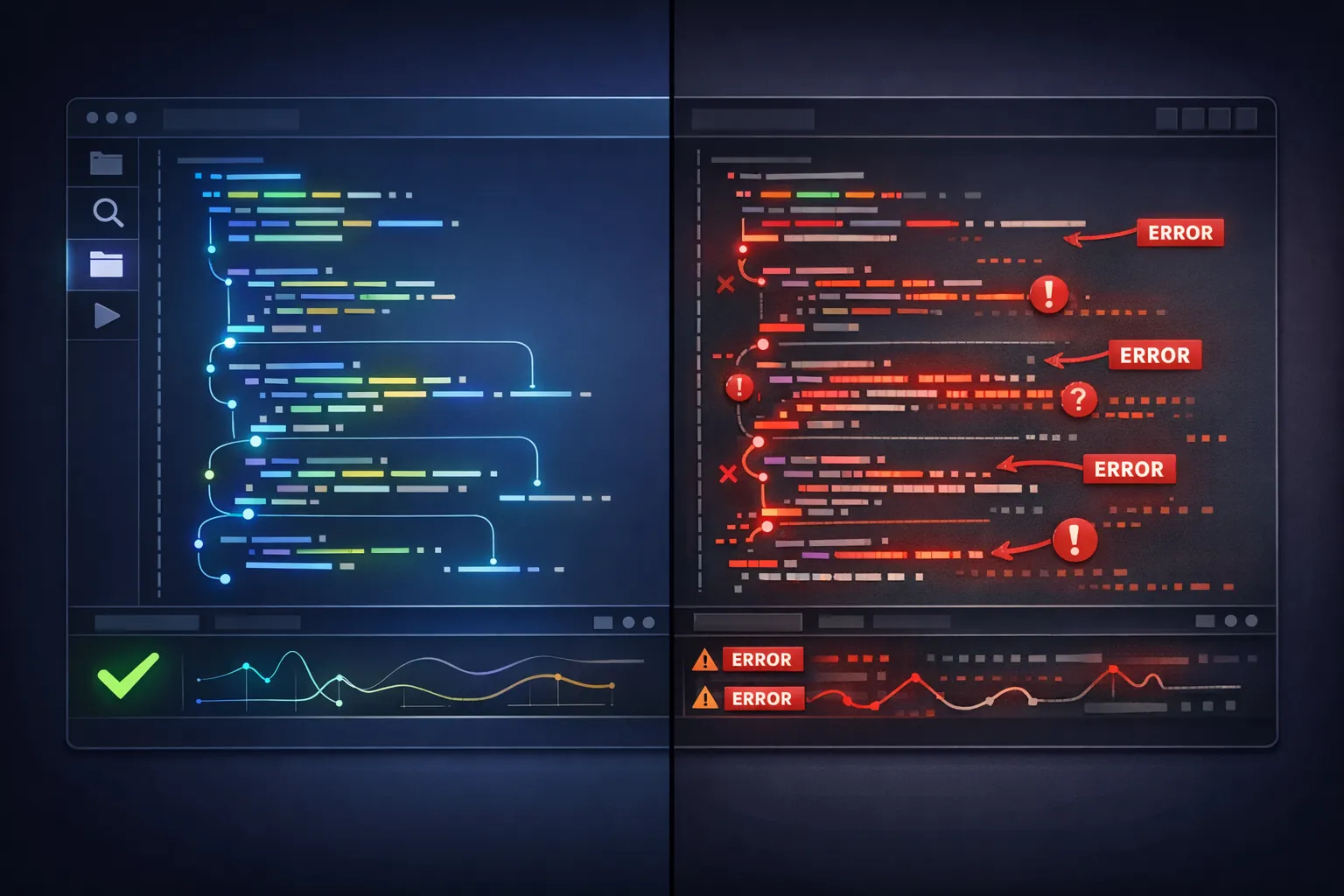
What AI Coding Agents Can Do Today
Autonomous code generation
Modern AI agents can generate complete features, not just code snippets. Given a well-specified task and access to the codebase, an agent can:
- Read existing code to understand patterns, conventions, and architecture
- Generate implementation code across multiple files
- Create appropriate data models, API endpoints, business logic, and UI components
- Follow existing coding standards and project conventions
- Handle boilerplate and plumbing code that would take a developer hours
What they handle well: CRUD operations, API endpoints, data transformations, standard UI components, configuration files, database migrations, and well-established patterns.
Where they struggle: Novel algorithms, complex business logic that is not well-specified, performance-critical code, and anything requiring deep domain knowledge that is not in the codebase.
Test generation and execution
This is arguably where AI agents deliver the most consistent value. Testing is essential but repetitive, and many teams under-invest in it. AI agents can:
- Analyze code to identify test cases (happy path, edge cases, error conditions)
- Generate unit tests, integration tests, and end-to-end tests
- Run the test suite and iterate on failing tests
- Achieve meaningful code coverage without the developer writing test code manually
A development team we work with at IT-Trail increased their test coverage from 34% to 78% in two weeks using an AI agent focused exclusively on test generation. The agent generated over 400 test cases, of which approximately 85% were kept after human review.
Bug detection and fixing
AI agents excel at a specific class of debugging:
- Pattern-based bugs — Null pointer dereferences, off-by-one errors, resource leaks, race conditions. Agents identify these by pattern recognition across the codebase.
- Regression bugs — When a change breaks existing functionality, agents can trace the failure back to the problematic change and propose a fix.
- Dependency issues — Version conflicts, breaking API changes, and compatibility problems.
Practical numbers: Teams using AI agents for bug detection report catching 30-50% more bugs before they reach production, with the most significant gains in catching issues that traditional static analysis tools miss.
Code review
AI-powered code review complements human reviewers:
- Consistency checks — Does the new code follow project conventions?
- Bug detection — Common error patterns, security vulnerabilities, performance issues
- Documentation gaps — Missing or outdated comments and documentation
- Complexity analysis — Flagging overly complex code that should be simplified
The key word is “complements.” AI code review catches a different set of issues than human review. Humans are better at evaluating architectural decisions, questioning business logic, and catching subtle design problems. The combination is more effective than either alone.
Documentation
Documentation is the perpetual weak point of software projects. AI agents can:
- Generate API documentation from code
- Write README files and setup guides
- Create architecture decision records
- Update documentation when code changes
- Translate documentation between languages
This is an area where AI agents are genuinely better than most human developers — not because the quality is superior, but because the documentation actually gets written.
DevOps and infrastructure
AI agents are increasingly capable in the operational side of software development:
- CI/CD pipeline management — Creating, updating, and troubleshooting build and deployment pipelines
- Infrastructure as code — Generating and modifying Terraform, Pulumi, or CloudFormation configurations
- Monitoring and alerting — Setting up dashboards, configuring alerts, and analyzing logs
- Incident response — Diagnosing production issues using logs and metrics, suggesting or executing remediation steps
Productivity Impact: What the Numbers Say
The productivity impact of AI agents in software development is significant but nuanced. Here is what we observe across teams we work with:
Where productivity gains are highest (50-80% time reduction)
- Boilerplate code and repetitive patterns
- Test writing
- Documentation
- Code migrations (framework upgrades, language version updates)
- Bug fixes for well-understood issue classes
Where gains are moderate (20-40% time reduction)
- Feature development for well-specified requirements
- Code review
- Debugging complex issues
- Refactoring
Where gains are minimal or negative
- Architecture design and system-level decisions
- Ambiguous or poorly specified requirements
- Performance optimization requiring deep analysis
- Novel problem-solving without clear patterns
The net effect
Across the teams we work with, the average productivity improvement is 30-45% measured by story points or feature delivery speed. But this number conceals important variation:
- Junior developers see the largest absolute gains. AI agents help them produce code faster and at a quality level closer to senior developers.
- Senior developers see more modest gains in raw output but significant time savings on review, documentation, and mentoring.
- The team overall benefits from higher code quality, better test coverage, and more consistent documentation — improvements that compound over time.
Practical Setup: Integrating AI Agents into Your Development Workflow
Tool selection
The landscape of AI coding agents is evolving rapidly. As of early 2026, the major options include:
- Claude Code / Claude with tool use — Strong at complex, multi-file tasks with excellent reasoning. Works well for both greenfield development and work on existing codebases.
- GitHub Copilot Workspace — Tightly integrated with the GitHub ecosystem. Good for teams already using GitHub for version control and CI/CD.
- Cursor / Windsurf — IDE-based agents that combine code editing with agentic capabilities.
- Custom agent setups — Using agent frameworks (LangChain, CrewAI, AutoGen) to build development agents tailored to your specific workflow.
The right choice depends on your existing toolchain, team size, and the types of tasks you want to automate.
Workflow integration
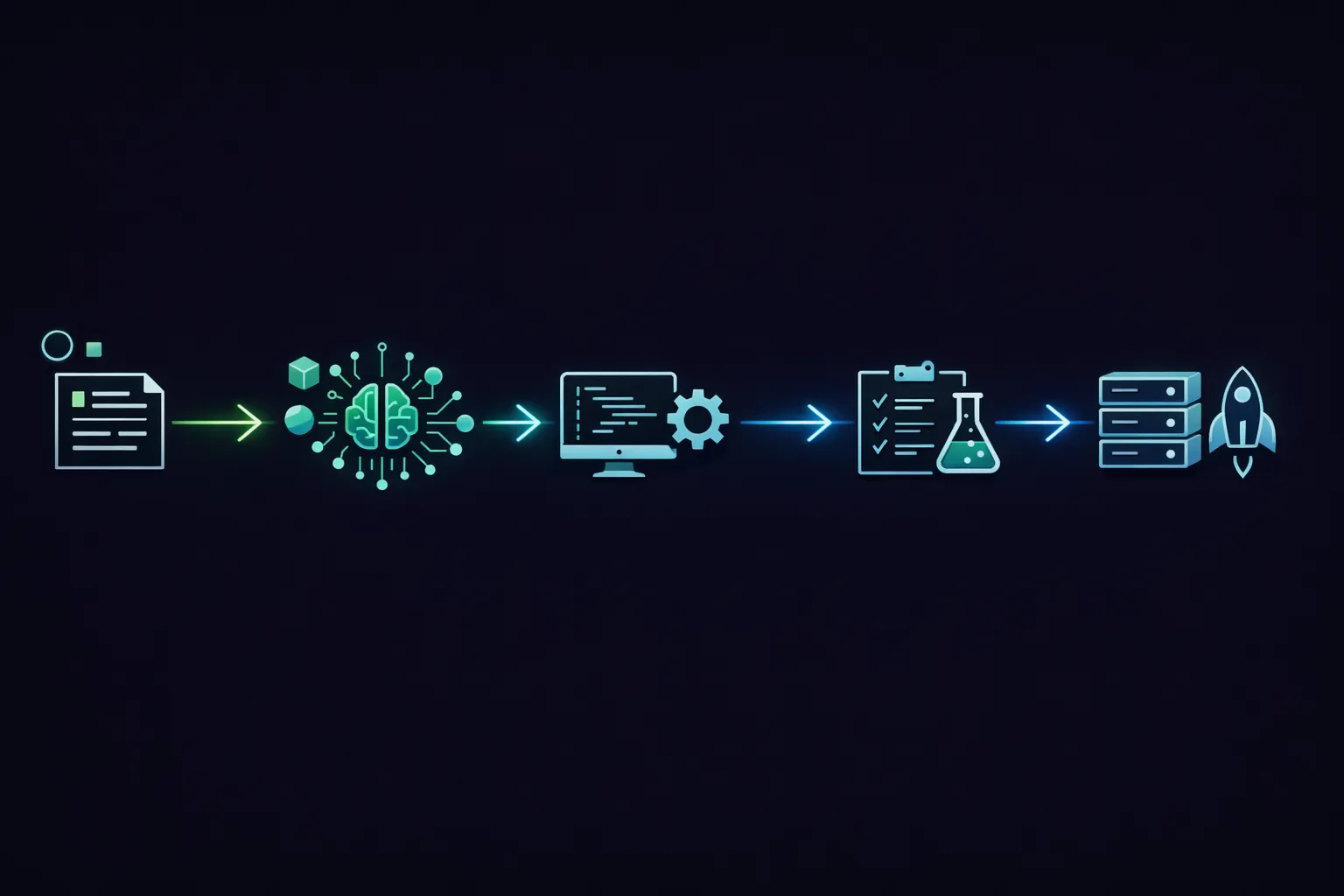
The most effective pattern we have seen is not to replace the development workflow but to integrate agents into it:
- Task specification — Developer or product manager writes a clear task description (ticket, user story, or natural language brief).
- Agent execution — AI agent generates the implementation, including code, tests, and documentation.
- Human review — Developer reviews the agent’s output. This is the critical quality gate.
- Iteration — Developer provides feedback. Agent revises. This cycle typically takes 1-3 rounds.
- Merge — Reviewed code enters the standard CI/CD pipeline.
This keeps humans in control of quality and architecture while offloading the mechanical work of writing code.
Setting up guardrails
AI agents writing code introduces specific risks that need management:
Code quality standards. Configure linters, formatters, and static analysis tools that run automatically on agent-generated code. The agent should not be able to bypass your quality gates.
Security scanning. AI agents can inadvertently introduce security vulnerabilities — hard-coded secrets, SQL injection vectors, insecure configurations. Automated security scanning is essential.
Scope limits. Define what the agent can and cannot do. Can it modify database schemas? Can it change CI/CD configurations? Can it install new dependencies? Set clear boundaries.
Audit trails. Log all agent actions. Know what code was AI-generated versus human-written. This matters for compliance, debugging, and intellectual property management.
Real-World Implementation Examples
Example 1: API migration
Situation: A SaaS company needed to migrate 120 API endpoints from REST to GraphQL. Manual estimation: 6 developer-months.
Agent approach: An AI agent analyzed each endpoint, generated GraphQL schemas, resolvers, and updated tests. A senior developer reviewed each batch.
Result: Completed in 6 weeks with 2 developers reviewing (approximately 1.5 developer-months of human effort). 94% of generated code passed review on first or second iteration.
Example 2: Legacy codebase modernization
Situation: A financial services company had a PHP 7.4 application that needed upgrading to PHP 8.3 with modern patterns.
Agent approach: AI agent identified deprecated functions, updated syntax, added type declarations, and updated tests. Work proceeded file by file with human review.
Result: 80% of files migrated with minimal human intervention. The remaining 20% (complex business logic, database interactions) required significant human involvement. Total effort reduced by approximately 60%.
Example 3: Test coverage improvement
Situation: An e-commerce platform with 22% test coverage needed to reach 70% before a major refactoring.
Agent approach: AI agent analyzed untested code paths, generated unit and integration tests, ran them, and iterated on failures.
Result: Reached 74% coverage in 3 weeks. Of approximately 800 generated tests, 710 were kept after human review. The team reported catching 12 previously unknown bugs during the process.
What This Means for Development Teams
The developer role is changing, not disappearing
AI agents handle an increasing share of code writing. This shifts the developer’s role toward:
- System design and architecture — Making the high-level decisions that agents cannot
- Requirements analysis — Translating business needs into clear specifications that agents can execute
- Quality assurance — Reviewing AI-generated code and ensuring it meets standards
- Agent orchestration — Configuring, fine-tuning, and managing AI agents effectively
- Complex problem-solving — Tackling the problems that require creativity and deep expertise
Team structure implications
Teams adopting AI agents effectively tend to evolve toward:
- Fewer but more senior developers
- Stronger emphasis on code review skills
- More investment in testing infrastructure and CI/CD
- Closer collaboration between developers and product/business stakeholders
- Dedicated effort for agent configuration and prompt engineering
Skills to develop
Developers who want to stay ahead should invest in:
- System design — The skill that matters most as code writing becomes automated
- Prompt engineering and agent configuration — Effectively directing AI agents is a skill that improves with practice
- Code review — Reading and evaluating code becomes more important than writing it
- Testing strategy — Knowing what to test and how, even if the tests themselves are AI-generated
- Domain expertise — Deep understanding of the business domain becomes a differentiator that AI cannot easily replicate
How IT-Trail Supports Development Teams
At IT-Trail, we help development teams integrate AI agents into their workflows practically and effectively:
- Assessment — We evaluate your current development process and identify where AI agents will deliver the highest impact.
- Tool selection and setup — We help you choose and configure the right AI coding tools for your stack and workflow.
- Workflow design — We design integration patterns that keep humans in control while maximizing agent productivity.
- Training — We train your developers on effective agent collaboration, prompt engineering, and AI-aware code review.
- Custom agent development — For teams with specialized needs, we build custom AI agents tailored to your specific codebase, tools, and processes.
Our approach is always grounded in practical results. We measure productivity impact, code quality, and team satisfaction — not just technology adoption.
Looking Ahead
The trajectory is clear: AI agents will handle an increasing share of the mechanical work in software development. Within 2-3 years, it is reasonable to expect that 60-70% of production code will be AI-generated (up from approximately 30-40% today in agent-adopting teams).
This does not mean fewer developers. It means each developer produces more, and the nature of the work shifts toward higher-value activities. The teams that adapt to this shift — learning to direct, review, and collaborate with AI agents — will build better software, faster.
The teams that resist will find themselves outpaced by competitors who embrace the change.
The best time to start integrating AI agents into your development workflow was six months ago. The second-best time is now.
Want to integrate AI agents into your software development workflow? IT-Trail GmbH supports you from strategy to implementation. Book a free consultation and let’s discuss your opportunities together.